Saturday, March 25, 2017

Why the growth in wages is so slow

Economists may not be much chop at forecasting how fast the economy will grow in the next year or two, but that doesn't mean they haven't learnt a few things about how economies work that the rest of us could benefit from knowing.

It helps us get a better handle on the future if we remember the macro-economists' rule that economies move in cycles, not straight lines.

So something that's been going down will, one of these days, start going back up, and vice versa.

A related rule is that, at any point in time, what's been happening in the economy will be partly the result of "cyclical" (and thus temporary) factors, and partly the result of "structural" (longer-term, lasting) factors.

At any particular time, the bigger, easier-to-see factor is likely to be cyclical influences; the smaller, harder-to-see factor is the underlying, longer-term structural (or "secular") trend.

Let's use this understanding to look at the present weak rate of growth in wages.

As measured by the Bureau of Statistics' wage price index, wages have usually grown by between 3 and 4 per cent a year in nominal terms, though they got up to 4.3 per cent just before the global financial crisis.

Since their subsequent peak of 3.7 per cent over the year to September 2012, however, their rate of growth has slowed continuously to a pathetic 1.9 per cent over the year to December.

Some people have leapt to the conclusion that employers have finally got the upper hand over workers, so that wage slaves will never get another decent pay rise again and, indeed, will probably see their rises get even more microscopic.

Sorry, it ain't that simple.

The question of what's causing wage growth to be so low is examined in an article by James Bishop and Natasha Cassidy in the latest Reserve Bank Bulletin.

Not surprisingly, they account for much of the weakness as caused by cyclical factors – by the relatively weak state of the labour market.

Note that the fall in the rate of wage growth began after the prices we receive for our exports of coal and iron ore stopped shooting up and started falling rapidly.

When our "terms of trade" – export prices relative to import prices – were improving, the nation's real income was rising strongly (because we could now buy more imports with the same quantity of exports) and it wasn't surprising to see our wages growing strongly, more strongly than consumer prices were growing.

But when our terms of trade began deteriorating, it was equally unsurprising to see wages start growing more slowly, especially relative to consumer prices.

Roughly a year after minerals export prices started falling, the amount of mining construction activity began falling sharply as projects were completed and no new ones were begun.

Thus began a period of weakness in the economy. Mining construction activity contracted and we began the slow transition back to an economy led by the other sectors, which had been held back by the expansion of mining.

Economists expect wage growth to be slower when there's "slack" in the labour market – when unemployment is higher than normal, employers have less trouble finding the workers they need and workers and their unions are less inclined to campaign for big pay rises.

With the actual unemployment rate fairly steady at 5.8 per cent,  but economists having revised their estimate of full employment (known to economists as the non-accelerating-inflation rate of unemployment) down to 4.75 per cent, plus a relatively recent rise in under-employment, there's plenty of reason to expect wage rises to be small.

And, of course, there's less need for big pay rises because consumer price rises have been below the bottom of the Reserve Bank's 2 to 3 per cent inflation target for the past two years.

There's a circular, chicken-and-egg relationship between prices and wages. Wages don't need to rise as much when prices aren't rising much, but prices don't rise much when wages (the biggest cost most businesses face) aren't rising much.

Don't be a victim of what economists call "money illusion". It shouldn't matter to workers how big their wage rises are in nominal terms. What matters is how wages are rising relative to prices – that is, what's happening to real wages.

The good news is that real wage growth has generally been positive in recent years.

The bad news is that real increases have been minuscule, whereas in a normally functioning economy they should grow by a per cent or two most years, as workers get their share of the continuing improvement in the productivity of their labour.

The first point to make is that there are good cyclical reasons for wage growth to be low, meaning that as the economy completes its transition to more normal sources of growth, we can expect a return to more normal rates of consumer price inflation and wage rises.

But here at last is the point: the Reserve's Bishop and Cassidy admit that all the normal cyclical factors we've discussed simply aren't sufficient to fully explain why wage growth is so weak.

That is, there does seem to be some underlying structural change at work. And it's not peculiar to Oz.

"It has been posited in the international literature that low wage growth may reflect a decline in workers' bargaining power," they say.

With all the globalisation of production, all the technological change and digital disruption – plus, in Australia and elsewhere, all the changes to wage-fixing arrangements to shift bargaining power back to employers – that's not hard to believe.

It's a warning to governments that if they want to see their economies return to normal functioning - and workers return to voting for mainstream parties – they should have another think about whether they've got the balance of industrial relations bargaining power right. Doesn't look like it.
Read more >>

Wednesday, March 22, 2017

The future of work won't be as bad as we're told

I can't remember when there's been so much speculation about what the future holds for working life. Or when those who imagine they know what the future holds have worked so hard to scare the dickens out of our kids.
Getting on for 100 years ago – 1930, to be precise – the father of macro-economics, John Maynard Keynes, wrote an essay, Economic Possibilities for our Grandchildren, in which he calculated that if technological progress produced real economic growth per person averaging 2 per cent a year for 100 years, by then people would enjoy a comfortable standard of living while needing to work only 15 hours a week.
He was writing during the Great Depression, so I doubt if many people believed him. He was right, however, to predict the Depression would end and growth would resume, powered by continuing advances in technology.
By the 1960s and early '70s it was common for futurologists to predict that more and more labour-saving technology would allow big reductions in the standard 40-hour working week.
What a laugh. Today's futurologists – amateur and professional – are predicting roughly the opposite to what Keynes and the '60s futurologists were.
Thanks to continuing technological advance and the digital disruption it's producing, working life is getting ever tougher and less secure, we're told.
As we learnt last week, all the extra jobs created in Australia over the year to February – a mere net 100,000 – were part-time, with full-time jobs actually falling by 21,000.
So there's the proof we're going to the dogs – and it'll keep getting worse. All those part-time and casual jobs. The growing army of the "under-employed".
We're moving to the "gig economy", where full-time, permanent jobs become the exception and most workers are employed on short-term contracts, many are self-employed like Uber drivers or need a "portfolio" of jobs on different days.
Frightening, eh? I read someone confidently assuring school kids they'd have 10 different jobs – or was it 10 different occupations? – in their working lives. Then I read someone assuring kids they'd have 17 different jobs. Not 16, or 18, but 17.
This growing job insecurity is why there's a renewed push among progressives – including Greens leader Richard Di Natale – for a "universal basic income". It'll be needed because so many people will be earning little or nothing from employment.
Have you detected my scepticism? This is people during a period of weakness in the jobs market predicting – like Keynes's pessimists – it will stay weak forever – and get worse.
That's part of it. The other part is the futurologists who, unlike us mere mortals, can see with perfect clarity what our technological future holds.
If you think economists aren't good at forecasting, futurologists are much worse. Much of what they predict never comes to pass and most of what they correctly predict takes much longer than they expected. Then there's the things they failed to predict.
The only safe prediction is that the future will be different to the present. Any more specific prediction is mere speculation.
The futurologists generally know – or profess to know – a lot more than the rest of us about all the new tricks the latest technology will soon be able to do. What they almost always underestimate is the human factor: whether we'll want it to do those tricks.
If the futurologists had been right, by now most of us would be working from home. We aren't – because it suits neither bosses nor workers.
It's tempting to predict the digital revolution will eliminate many jobs in the services sector, leading to mass unemployment.
Trouble is, employers have been installing labour-saving equipment since the start of the Industrial Revolution, and so far the unemployment rate is hardly up to double figures.
That's because improving the productivity of a nation's labour increases its real income. When that income is spent, jobs are created somewhere in the economy.
Technological advance doesn't destroy jobs, it "displaces" them from one part of the economy to another.
It's possible the digital revolution is so different to all previous technological revolutions that what's been true for 200 years is no longer true. Possible, not probable.
Those predicting our kids will be tossed out of their jobs many times in their working lives forget that market forces involve the interaction of supply and demand.
Their prediction of almost universal job insecurity in the gig economy assumes this will happen because it's what the demanders of labour – employers – want.
This is naive. It assumes all labour is unskilled – so employers don't care who does it and never have trouble recruiting and training a constantly changing workforce – and that there's no such thing as "firm-specific knowledge".
No employer would treat skilled labour in such a cavalier fashion. Employers know the suppliers of labour – employees – wouldn't want to work for such an appalling outfit.
And such an apocalyptic prediction fails to allow for what economists call the "policy reaction function" – if things get too bad for too many workers, governments will step in and legally require employers to treat their staff fairly – just as they already impose paid public holidays, annual leave, minimum wages, penalty payments and much else on unwilling employers.
Why do they do it? Because, in a democracy, workers have far more votes than bosses.
Read more >>

Monday, March 20, 2017

Someone has to give if we’re to fix the budget

The nation's budget problem still won't be solved when, one day in the distant future, we get the federal budget back into surplus. Only a change in strategy is likely to produce a sustained solution.

As successive intergenerational reports demonstrate, on present policies government spending will just grow and grow, requiring ever-higher taxes.

If we don't like that idea – or politicians regard it as an impossible sell – we need to think a lot harder about what we're spending on, why it's growing so fast, what things we should stop spending on, and how we can make our spending more effective, in the process slowing the rate at which it's growing.

The five biggest areas of spending include welfare benefits, health, education and infrastructure. Infrastructure's too important to share a column, so we'll return to it.

But it, plus health and education, are even bigger when you remember how they dominate the states' budgets – a reminder that federal and state budgets need to be considered together, and that cutting federal grants to the states, and cost-shifting by the states back to the feds, aren't genuine solutions.

Of three categories – welfare benefits, health and education – the intergenerational reports make it clear health will be by far the fastest growing.

That's not so much because of ageing as because advances in medical technology are hugely expensive, and it's quite unrealistic to imagine that Australian voters will settle for anything less than gaining subsidised access to the latest and best technology ASAP.

Since this is the political reality, the problem (and much of the pressure on budgets) is easily solved.

Our politicians simply need to be brave and tell voters the truth: if they want ever more and better healthcare then, as with everything else, they'll have to pay more for it – in the form of, say, regular increases in the Medicare levy.

That's the fundamental solution, but we could also do more to slow the rate of growth in healthcare spending by removing at least some of the waste and inefficiency that everyone in the system tells us exists.

Much could be done to make education spending more effective. Instead, however, since the national knockback of the 2014 federal budget, the government's done little but crack down on the previous year's crackdown on the welfare cheats the Liberal hard right has convinced itself are ripping off billions every year.

Sorry, not nearly good enough. Nor is preaching the evils of tax increases while you wait for bracket creep to claw back the eight successive tax cuts we were awarded when Peter Costello thought the resources boom would run forever.

The trouble with many professed supporters of Smaller Government is that they want to have their cake and eat it.

They want to reduce government spending so they can pay less tax, but they don't want to give up the middle-class welfare they enjoy – much of it awarded to them by the great man who didn't believe in smaller government, John Howard.

Much of Howard's handouts to the comfortable came in the fifth big spending area, tax expenditures – which have the same cost to the budget as ordinary expenditures, but are hidden away on the tax side where they aren't noticed.

These include various new benefits for supposedly self-funded retirees, the private health insurance tax rebate, big increases in grants to non-government schools and Costello's unsustainably generous increase in superannuation tax concessions for high income earners.

To be fair, Malcolm Turnbull has made a good start to cutting back the super concessions – over the vociferous opposition of his hard right backbench.

More must be done to cut back rapidly growing tax expenditures.

But if we're genuine about achieving fiscal sustainability while restraining the rise in tax rates, we need to embrace a new principle to sit beside our heavily means-tested welfare system (which is the main reason Australia's overall level of taxation is so much lower than almost every other developed economy).

The companion principle should be: we're no longer prepared to subsidise positional goods in the name of encouraging "choice".

We'll put all our effort into providing a good public health system and a good public education system, and that's it.

Of course, it's a free country and if you think you can do better than the public system by making private arrangements, feel free.

But don't expect other taxpayers to subsidise your efforts to get better than they're getting.

In any case, the easier you make it for punters to enjoy positional goods, the less positional you make them, cheating the better-off of their feeling of superiority.
Read more >>

Saturday, March 18, 2017

Dig deep and you find the two-speed worm has turned

If you learn nothing else about the economy, remember that it moves not in straight lines but in cycles of good times followed by bad times, and bad times followed by good.

Nowhere is that truer than with our famed "two-speed economy".

For most of the decade to 2012, the resources boom meant that the two main mining states – Queensland and, especially, Western Australia – were growing much faster than the rest of the economy, which was being held back by the effect of the boom-caused high dollar on other export industries.

For the past few years, however, the roles have been reversed, with Queensland and WA now growing much more slowly than Victoria and NSW.

In an article in the latest Reserve Bank Bulletin, Thomas Carr, Kate Fernandes and Tom Rosewell argue that looking at what's been happening from state to state does much to help explain what the Australian Bureau of Statistics is telling us about developments in the national economy.

It also helps explain why Colin Barnett was thrown out of office so unceremoniously in WA last Saturday. Forget the politicos' obsession with the role of One Nation, the deeper explanation is economic.

After peaking at growth of 9.1 per cent in gross state product (the state equivalent of gross domestic product) in 2011-12 at the height of the mining boom, growth slumped to just 1.9 per cent in 2015-16.

There's nothing new about governments getting tossed out when their boom turns to bust. Especially when it becomes apparent what a hash you made of the good times, spending like there was no tomorrow.

To see how the two-speed worm has turned, consider this. In 2015-16, real GDP grew by 2.8 per cent for the year as a whole.

Within this, NSW's real GSP grew 3.5 per cent and Victoria's 3.3 per cent. By contrast, Queensland's grew 2 per cent and, as we've seen, WA's 1.9 per cent. (If you must know, South Australia's was 1.9 per cent and Tasmania's 1.3 per cent.)

What's that? You think WA's annual growth of 1.9 per cent doesn't sound all that terrible? It's being held up by the increased volume of WA's exports of iron ore and liquefied natural gas.

Trouble is, that generates next to no additional jobs. In mining, most of the jobs come from building new mines. When construction ends, the building workers go back where they came from (which ain't Perth).

Our trio from the RBA say that, over the period of the resources boom's build-up and let-down, differences between the performance of the states have been explained mainly by differences in private investment spending.

Consumer spending accounts for a far bigger slice of GDP/GSP than investment spending. And consumer spending has been much less variable between the states than investment spending – although it's been weakest in WA.

Consumers keep their spending reasonably smooth from year to year. They do this by cutting back their rate of saving when their incomes aren't growing fast enough.

We know from the national accounts that, while wages and employment growth have been weak in recent times, households have been progressively lowering their rate of saving to help keep their consumption steady.

That's normal cyclical behaviour. What we now know from the RBA trio's investigations, however, is that pretty much all the decline in the national saving ratio is explained by the actions of West Australians and Queenslanders. Ah.

Another national-level story we're familiar with says the economy is making a transition from mining-led to non-mining-led growth. So, as mining projects are completed and mining investment spending falls way back, we need strong growth in non-mining business investment to take its place.

The national accounts tell us it's not been happening. You've heard all the wailing and gnashing of teeth – not to mention speculation about causes – that's accompanied this bad news.

But here again the RBA trio's data diving shows the story in a different light. While mining investment was booming in the mining states, so was non-mining investment in those states. Confidence in one part of the local economy spills over to other parts.

While this was happening in the mining states, non-mining business investment in the other states was weak.

As the trio almost admit, this was part of the RBA's dastardly plan to ensure the mining boom didn't cause runaway inflation – as every previous commodity boom had.

While the politicians were letting foreign miners make all the crazy investments we now realise they did – leaving us with a gas-bonanza-caused energy crisis – the RBA had to "make room" for the miners by holding back the rest of the economy and, in particular, non-mining business investment.

It would have been willing to achieve this restraint by holding interest rates higher than otherwise needed but, fortunately for it, most of the work was done by the abnormally high exchange rate, which crunched manufacturers, tourism and foreign student education.

Back to the now. While the national figures reveal non-mining investment failing to show signs of recovery, the trio's data diving shows it's actually falling in the mining states (as lack of confidence in mining spills over) but recovering elsewhere.

In NSW, non-mining investment has grown at an average rate of 8 per cent a year for the past three years. In Victoria, it's been 4 per cent.

The obvious explanation for this recovery is the dollar's return to earth. But much of it's been in business services, including, in NSW, construction of new office buildings. In Victoria, there's been investment in wholesale and retail, with investment by manufacturers stabilising.

But the other private investment category – new housing – is also part of the story. Home building has fallen in the West (what a surprise), but grown strongly in NSW and Victoria.

It's surprising what you discover when you dig.
Read more >>

Wednesday, March 15, 2017

Private schools becoming less fashionable

It's drawn little comment, but the decades-long drift of students from government to non-government schools has ended.

Figures released by the Bureau of Statistics last month show that 65 per cent of our 3.8 million students went to public schools in 2016, the same proportion as in 2013. If anything, the public-school share is creeping up.

The non-government share divides between Catholic systemic schools with 20 per cent and independent schools with less than 15 per cent. I'll refer to both as private schools.

But the public schools' 65 per cent today is down from 79 per cent in 1977.

Let's start by trying to explain those many years of drift before we wonder about why it's stopped.

When Ipsos Public Affairs asked people why they thought other people sent their kids to private schools, the most commonly cited reasons included the higher standard of education (50 per cent), the better discipline (49 per cent), the better facilities (46 per cent), the size of classes (43 per cent) and because it's a status symbol (40 per cent).

Almost uniquely among other developed countries, Australian parents have a much higher proportion of private schools to choose, and have been given greater freedom to choose between government schools.

Successive federal and state governments have seen greater parental choice between public and private as a virtue, and have encouraged it by increasing their combined grants to private schools at a much faster rate than their funding of public schools.

But I have my own theory on why so many people have opted for private schooling. I think a lot of it gets down to parental guilt.

These days families have much fewer children, which means parents take a lot more active interest in their kids' schooling than they did when I was the last of four.

And these days both parents are more likely be in paid work – meaning they have more money to spend, but see less of their kids than their parents did.

So what more natural than for parents to believe that, in their decisions about how to spend their income, ensuring their kids get the best education possible should have high priority.

And what's more natural in our market economy than to assume that the more you have to pay for something, the higher quality it's likely to be.

It's the old male cop-out, spread to women: I may not see as much of my kids as I'd like to, but I'm working night and day so I can afford to give them the best of everything.

The more materialist you are, the more you're inclined to judge a school by the quality of its facilities – gyms and swimming pools, music, art and drama theatres – than by the quality of its teachers.

Of course, the former is, as economists say, much more "observable" than the latter.

But whatever people give as their reasons for preferring private schools, you'll never convince me they're not well aware of the status they gain by sending their kids to private schools, especially independent schools.

Private schools are among the things economists classify as "positional goods" – they reveal your position in the pecking order.

But what's changed? Why has the drift to private schools come to an end?

One possibility is that the slow wage growth of recent years has made it harder for parents to afford private school fees.

This may be particularly the case for independent schools, where the rate of increase in fees from year to year bears little relationship to rate at which teachers' salaries are rising.

Nor does the rate at which government grants have been growing seem to have had much effect in slowing the rate at which independent school fees have grown. (The extra government grants may have gone into improving schools' facilities.)

My guess is that, as economic textbooks predict, independent school fees rise according to what the market will bear. They judge how strongly demand for their product is growing relative to supply by the length of their waiting lists.

In any case, keeping the cost of independent schooling high is an essential element in maintaining its status as a positional good.

Another possible contributor to the end of the drift to private schools is the decision of state governments – particularly NSW governments – to increase the number of places at selective schools. Why pay fees when you can get what you want inside the government system?

As a parent who's had one of each – independent and selective – I can assure you selective schooling works well as an (intellectual) positional good.

But there's one last possible contributor to the end of the trend to private schools: maybe parents are realising that paying all those fees doesn't buy your kid superior academic results along with their old school tie.

Julia Gillard's My School website has done little to encourage greater competition between schools (a silly idea she got from economists), but it has provided a fabulous database for education researchers.

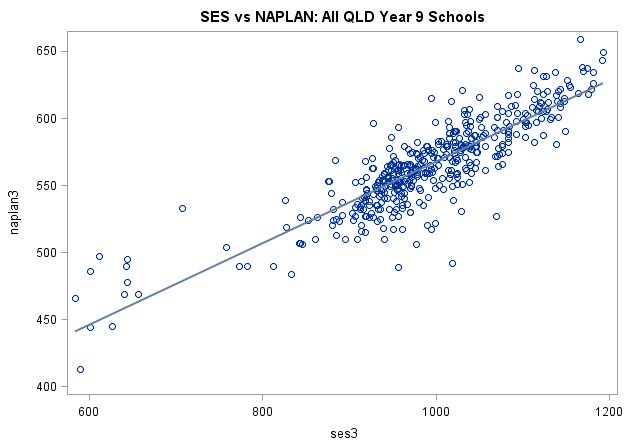
Various researchers have used it to demonstrate that the best predictor of children's academic results is the socio-economic status (including level of educational attainment) of their parents.

And when you take account of parents' socio-economic status, there's little evidence that kids of similar backgrounds do any better academically at one kind of school than another.
Read more >>